
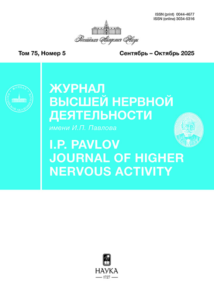
Homepage

Zhurnal Vysshei Nervnoi Deyatelnosti Imeni I.P. Pavlova

ISSN (print): 0044-4677

Media registration certificate: No. 010234 dated 02/09/1993

Founder: Russian Academy of Sciences

Editor-in-Chief: Balaban Pavel Miloslavovich

Number of issues per year: 6

Indexation:

RISC

Scopus

CrossRef

White List (level 3)

Web of Science

PubMed

В журнале публикуются результаты оригинальных теоретических и экспериментальных исследований по физиологии и патофизиологии высшей нервной деятельности, общей физиологии головного мозга и анализаторов, а также работы обзорного и критического характера, отчеты о научных сессиях и конференциях. Особое внимание уделяется статьям, в которых освещаются связи высшей нервной деятельности с философией, психологией, педагогикой, биологией.

Журнал основан в 1951 году.

Current Issue

Vol 76, No 1 (2026)

Year: 2026

Articles: 3

Full Issue

Open Access

Russian

PDF

The Impact of Proton Pump Inhibitors on the Efficacy of Dual Antiplatelet Therapy in PatientsFollowing Percutaneous Coronary Intervention: A Systematic Review and Network MetaAnalysis.

Jing Zhang¹,Xiaoli Hou², Wenxiang Ma¹,*

To investigate the effects of proton pump inhibitors (PPIs) on the efficacy of dual antiplatelet therapy (DAPT) in patients following percutaneous coronary intervention (PCI). A computerbased search was conducted in the Cochrane Library, ClinicalTrials.gov, and PubMed databases up to September 30, 2024. Randomized controlled trials (RCTs) evaluating the application of DAPT in conjunction with PPIs in post-PCI patients were included. This network meta-analysis included a total of 6 RCTs with 2,826 participants. The direct metaanalysis of the incidence of major adverse cardiovascular events (MACE) yielded a combined effect size of OR 0.87 (95% CI: 0.71, 1.06). Subgroup analyses by PPI type revealed an OR of 0.85 (95% CI: 0.70, 1.05) for pantoprazole, 0.49 (95% CI: 0.04, 5.59) for lansoprazole, and 1.83 (95% CI: 0.51, 6.53) for omeprazole. For gastrointestinal event incidence, the direct meta-analysis resulted in a combined effect size of OR 0.22 (95% CI: 0.10, 0.46). The ORs for pantoprazole, lansoprazole, and omeprazole were 0.23 (95% CI: 0.07, 0.70), 0.18 (95% CI: 0.02, 1.62), and 0.13 (95% CI: 0.02, 0.73), respectively. The network meta-analysis indicated that the preferred hierarchy for reducing MACE risk is lansoprazole, followed by pantoprazole and omeprazole. In contrast, for minimizing gastrointestinal event risk, the preferred order was omeprazole, followed by lansoprazole and pantoprazole. For patients after PCI, the combination of DAPT and PPIs is recommended to reduce the risks of cardiovascular and gastrointestinal events. Strong CYP2C19 inhibitors such as omeprazole and esomeprazole should be avoided.
Zhurnal Vysshei Nervnoi Deyatelnosti Imeni I.P. Pavlova. Vol (76), No 1
Clinical value of magnetic resonance dynamic enhancement in breast cancer diagnosis

Hongqun Du, Jiong Xing, Yunjuan Yin, Hongyan Qiao*

To analyze the application effect of magnetic resonance dynamic enhancement in the diagnosis of breast cancer. 126 patients with suspected breast cancer who were examined in imaging were selected and their clinical data were retrospectively analyzed. The patients were divided into benign breast lesion group(67 cases) and breast cancer group(59 cases) according to their pathological results. All patients underwent magnetic resonance dynamic enhancement scanning and ultrasonography before surgery. The diagnostic effects of magnetic resonance dynamic enhancement scanning and ultrasonography were compared. The imaging characteristics of the two groups were observed, and the reflux rate constant, transport constant and volume fraction blood flow parameters were compared between the two groups. The diagnostic effect of magnetic resonance dynamic enhancement scanning was better than that of ultrasonography. The percentage of lesions with irregular shape, burr sign, increased vascularity, uneven enhancement, and blurred borders was higher in breast cancer patients than in benign breast lesions group(P<0.05). The reflux rate constant, transport constant and volume fraction of patients in breast cancer group were significantly higher than those in benign breast lesion group, and reflux rate constant, transport constant and volume fraction of patients with highly malignant breast cancer were higher than those of the patients with low-grade malignant breast cancer(P<0.05).Resonance enhancement scanning can improve detection rate of early breast cancer, and can also quantitatively analyze blood flow characteristics of lesion with the help of blood flow parameters, which can provide a reference for judging the condition and evaluating the prognosis.
Zhurnal Vysshei Nervnoi Deyatelnosti Imeni I.P. Pavlova. Vol (76), No 1
Effects and Mechanisms of CARM1 on Cerebrovascular Endothelial Dysfunction After Subarachnoid hemorrhage

Qingtao Zhang¹, Yidan Liang¹, Qiang Yang¹, Lei Xu¹, Yongbing Deng¹, Min Cui¹, Weiduo Zhou¹, Chao Sun¹, Liu Liu¹*

Cerebral endothelial cell dysfunction plays a critical role in the pathophysiology of vascular injury subsequent to subarachnoid hemorrhage (SAH), yet the precise molecular mechanism remains largely speculative. Inflammation stands out as a pivotal contributor to an unfavourable prognosis post-SAH, with nuclear factor-κB (NF-κB) pathways being initiated and ultimately leading to inflammation activation and pro-inflammatory cytokine release following SAH. In this study, we explored the impact of the Coactivator-associated arginine methyl transferase 1 (CARM1) inhibitor TP-064 on inflammation in an in vitro SAH model. Exposure of endothelial cells to TP-064 resulted in a significant reduction in CAMR1 and NF-κB expression upon hemoglobin exposure. Similarly, endothelial cells treated with TP-064 following hemoglobin incubation exhibited decreased expression levels of intercellular adhesion molecule-1 (ICAM1), myeloperoxidase (MPO), and cytokine production including interleukin-1β (IL-1β), interleukin-12 (IL-12), tumor necrosis factor-α (TNF-α) in response to hemoglobin exposure. Moreover, subsequent investigations demonstrated that CARM1 transcriptionally regulates NF-κB via methylation. Additionally, TP-064 notably mitigated endothelial dysfunction. Collectively, our findings identify TP-064 as a CARM1 inhibitor targeting inflammation and neutrophil infiltration, offering new insights into therapeutic strategies for addressing endothelial cell dysfunction following SAH.
Zhurnal Vysshei Nervnoi Deyatelnosti Imeni I.P. Pavlova. Vol (76), No 1